
January 13, 2026
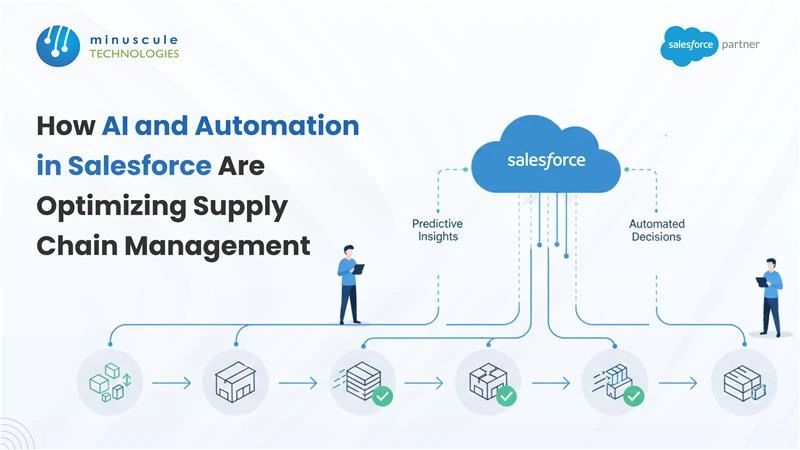
Salesforce is not a supply chain system, and any guide that implies otherwise will cost you a failed project. It does not run material requirements planning, it does not manage a warehouse, and it does not optimize freight routes. Your ERP, WMS, and TMS do those things, and Salesforce's own documentation tells you to integrate with them rather than replace them.
What Salesforce genuinely does is narrower and more valuable than the usual pitch: it holds the demand signal, it orchestrates orders and fulfillment routing, it manages the customer conversation when something goes wrong, and with Data 360 and MuleSoft it becomes the layer where data from the systems that do run your supply chain gets unified and acted on.
This guide draws that boundary precisely, names the current products, and sets out what has to be true before AI or agents add anything at all.
Start here, because most disappointment in this category traces back to a capability someone assumed was included.
The last five rows are where inherited marketing copy tends to overreach. Two deserve specific comment.
Route optimization is genuinely not a core Salesforce capability. Field Service optimizes technician travel for service appointments, which is a different problem from consolidating freight and tendering loads to carriers. There are capable transportation management systems built natively on the Salesforce platform and sold through AppExchange, so "route optimization on Salesforce" is achievable, but it comes from a partner product rather than something you switch on.
Purchase orders and invoice matching belong to your ERP. Three-way matching is an accounting control, and rebuilding it in a CRM is a well-known way to create an audit problem. Salesforce can trigger a requisition and show its status; it should not be your system of record for payables.
None of this makes Salesforce a weak choice. It makes it a specific choice, and knowing the boundary is what separates a project that ships from one that quietly expands until it is cancelled.
If you are reading material on this topic written even eighteen months ago, the product names will be wrong. Salesforce's AI branding has moved repeatedly.
The practical consequence: if a proposal or article leads with Einstein GPT, it was written against a product generation that has been superseded twice. The capability did not disappear, but the architecture and licensing around it changed, and advice built on the old model tends to be wrong about what is included.
The wider portfolio rename is covered in our breakdown of the Agentforce rebrand, and Salesforce Ben has tracked each transition as it happened.
Four roles, each defensible, each with a clear boundary.
Read the right-hand column as the honest scope of the project. Every role Salesforce plays well depends on something arriving from a system it does not own, which is why these programs are integration programs wearing a CRM badge.
This is the claim most often overstated, so it is worth being precise about the mechanism.
Salesforce holds something your ERP does not: the forward commercial picture. Open pipeline, account-level forecasts, and signed volume commitments are all demand intelligence that exists before any order is placed. AI applied to that data can weight opportunities by likelihood, surface accounts running behind commitment, and aggregate expected volume by period and region.
That is real value, and it improves the input to planning. It is not planning. Converting a demand number into a production schedule, a materials requirement, or a purchase plan is what your ERP does, using bills of material, lead times, and capacity constraints that do not exist in your CRM.
The honest framing for a business case is therefore this: Salesforce makes the demand signal earlier, richer, and better attributed. The planning system still has to consume it. If those two are connected by a monthly spreadsheet, better forecasting inside Salesforce changes very little.
For manufacturers specifically, the objects that carry this are sales agreements and account forecasts, which we cover in our map of Salesforce Sales and Service Clouds for manufacturing.
If one capability deserves more attention than it gets in this conversation, it is order orchestration, because it sits squarely inside Salesforce and directly affects both cost and customer experience.
Salesforce Order Management handles the order lifecycle after capture: validating it, deciding where it should be fulfilled from, splitting it across locations when necessary, handling cancellations and returns, and keeping the customer-facing record consistent throughout.
The sourcing decision is the interesting part. Given the same order, fulfilling from a distribution center, a dark store, or a retail location produces different delivery times, different shipping costs, and different downstream inventory positions. Encoding that logic well is a genuine margin lever, and it is one of the few supply-chain-adjacent decisions Salesforce is properly designed to make.
It has a hard dependency, though. Sourcing logic is only as good as the inventory position it reads. If availability is a nightly snapshot, the system will confidently promise stock that was sold hours ago. Getting to trustworthy, location-level availability is the prerequisite, and we treat it separately in our guide to real-time inventory control. Order Management APIs and the integration surface around them are documented on Salesforce Developers.
Consider the failure everyone in operations recognizes. A supplier has a machine failure overnight. The notification sits unread in a shared inbox. By the time anyone acts, the shipment is missed and the line stops.
It is worth being clear about which part of that Salesforce fixes. It does not detect the machine failure, and it does not find you alternative freight. What it does, once the exception reaches it, is turn a disruption into a managed communication rather than a series of angry inbound calls.
That is not a consolation prize. Most of the reputational damage in a supply chain failure is inflicted between the moment the problem becomes real and the moment customers hear about it honestly. Salesforce closes that gap: identifying every affected order and account, notifying them proactively on the channel they use, arming service with accurate status so answers are consistent, and offering self-service tracking so the volume never becomes calls.
The dependency is the same as everywhere else. You need the exception signal to arrive from the system that detected it. An integration that surfaces supplier and carrier exceptions into Salesforce is what makes proactive communication possible, and that belongs with integration architecture rather than service configuration. The service-side design sits with Service Cloud implementation.
Agentforce is a real shift, and it is worth separating from the marketing around it.
The shift is from prediction to action. Einstein scored and forecast; a human then did something about it. An agent can take the step: answering a status question from CRM data, drafting the customer notification, opening the case, updating the order. For operations teams whose day is largely lookup and relay, that is a meaningful reduction in manual work.
Three limits are worth stating plainly, because they determine whether an agent project succeeds.
An agent cannot see what you have not integrated. Asked where a truck is, it can only answer if carrier data reaches Salesforce. Agents are not a substitute for the visibility layer; they are a better interface onto one that exists.
An agent inherits your data quality. If the same part exists under two names, or inventory is a day stale, the agent will act confidently on the wrong version and do it faster than a human would have.
An agent needs a decision boundary. Which actions it may take alone, which need approval, and what it must never do are configuration decisions with commercial consequences. Reallocating scarce stock between two customers is a policy question, not a prompt.
Practitioner discussion in the Trailblazer Community is usually where the real limits of new agent capabilities surface first, ahead of the documentation.
The single most useful artifact in one of these programs is a table like this, filled in for your own estate before anyone builds.
The value of writing this down is that it converts an unbounded ambition into a scope. It also prevents the most expensive pattern in this category, which is two systems both believing they own inventory and quietly overwriting each other.
The fifth row is the one that surfaces during the first real shortage. When two customers want the last available units, an agent will apply whatever rule it was given. If nobody wrote one, someone will discover the default the hard way. Deciding it in advance is a commercial choice, and it belongs to the business rather than to whoever configures the automation.
Practical modules on Trailhead are a reasonable starting point for the platform mechanics, and the production-side automation patterns are covered in our walkthrough of automating production execution.
Partly, and it depends what you mean. Salesforce handles the demand signal, order orchestration and fulfillment routing, customer communication, and the unified data layer over your other systems. It does not do materials planning, warehouse operations, freight optimization, or payables. Used for what it is good at, it is valuable; used as an SCM replacement, it fails.
No. Salesforce's own retail supply chain guidance describes integrating with existing ERP and warehouse management systems, and Salesforce-native ERP vendors are explicit that Salesforce is not a supply chain system. Treat it as the customer-facing and orchestration layer above your ERP.
Not in core Salesforce. Field Service optimizes technician travel for service appointments, which is a different problem from freight consolidation and carrier tendering. There are transportation management systems built natively on the Salesforce platform and available through AppExchange, so it is achievable as a partner product rather than a native feature.
It was superseded. Einstein GPT arrived in 2023 as the first generative layer, became Einstein Copilot in 2024, and was rebranded into Agentforce. Einstein remains current for predictive scoring and forecasting. Material still centered on Einstein GPT is at least two generations out of date.
Three ways that hold up. It improves the demand signal by weighting and aggregating commercial data earlier. It removes lookup-and-relay work through agents that answer status questions and draft notifications. And it flags exceptions for human attention rather than waiting for someone to notice. It does not create visibility into systems you have not connected.
Not on current evidence. What it displaces is the manual gathering, checking, and relaying that fills a planner's day. The judgment calls, such as which customer gets scarce stock and whether to expedite at cost, are policy decisions someone has to own, and agents need those rules written down before they can act on them.
If your goal is a single reliable view across ERP, WMS, and CRM, you need something that resolves records across those systems, and Data 360 is the supported route within Salesforce. For a narrower goal, such as order orchestration against one inventory source, a well-designed integration may be enough. Decide the goal before the tooling.
The reactive supply chain is a real problem, and Salesforce genuinely helps with parts of it. But the version of this story that promises route optimization, invoice matching, and warehouse control from a CRM sets up a project that cannot deliver, and it damages credibility with exactly the operations and IT leaders who have to approve it.
The honest version is more useful. Salesforce owns the demand signal, the order, the customer conversation, and the unified data layer. Your ERP, WMS, and TMS own planning, warehouse execution, and freight. AI and agents make the Salesforce side faster and more proactive, and they do nothing whatsoever for data you have not connected or decisions nobody has defined.
Draw that boundary first, write down which system owns which field, decide your allocation policy before a shortage forces it, and then automate aggressively inside the lines.
At Minuscule Technologies we scope this work by mapping the boundary before proposing a build, because the integration and data model decide the outcome long before the AI does. If you want a clear view of which parts of your supply chain Salesforce should own and which it should only observe, talk to our team about a supply chain readiness review.
You've seen what's possible. Now, let's make it happen for your business. Whether you need an end-to-end Salesforce solution, a complex integration, or ongoing managed services, our team is ready to deliver.

Schedule a Free Strategic Call


Plot No. 4, Sridevi Amman Street, Perumal Nagar Extension, Old Pallavaram, Chennai, Tamil Nadu 600117, India.
