
November 19, 2025
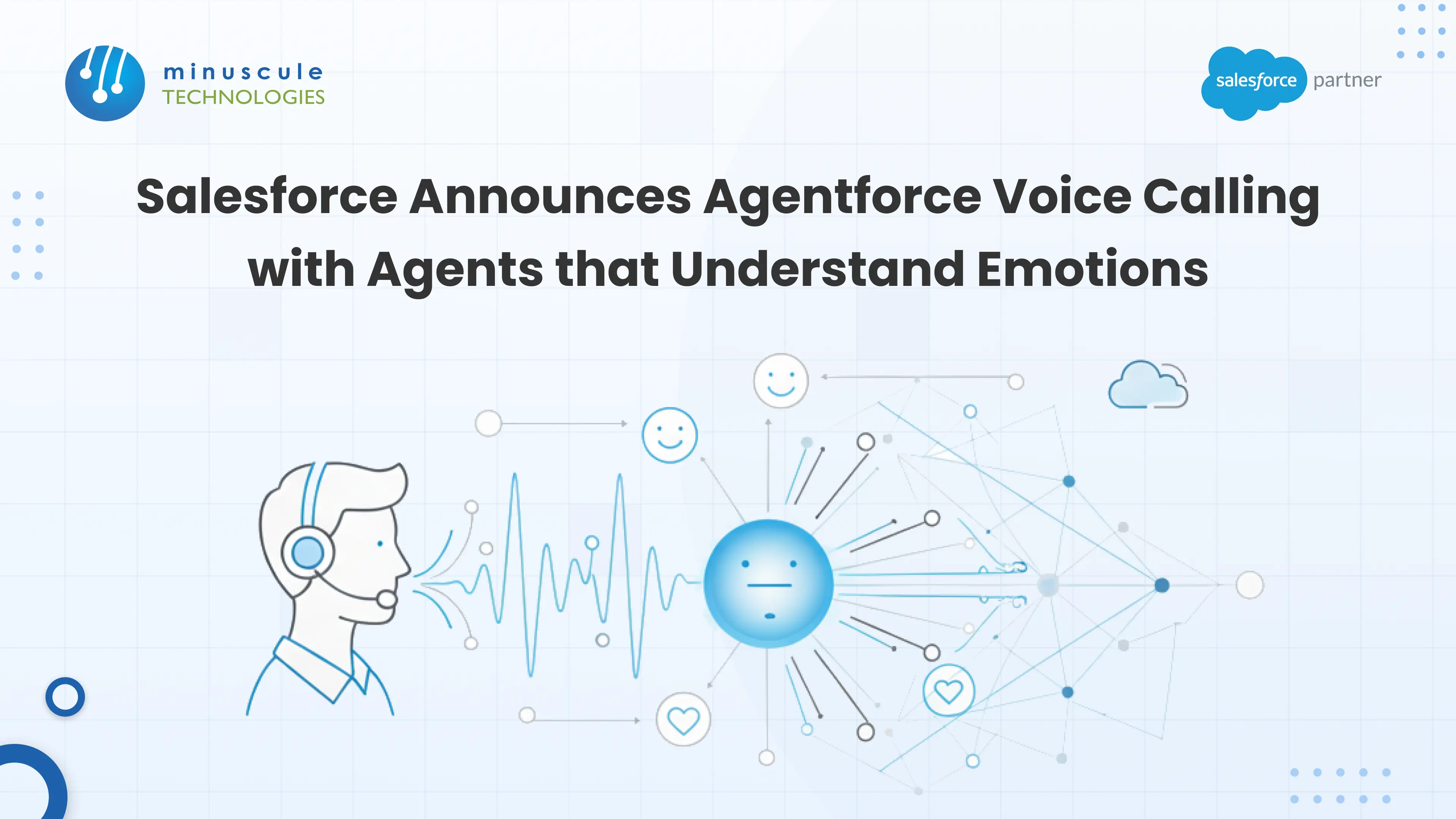
Agentforce Voice Calling is Salesforce's AI-powered voice agent, built natively into the platform. It listens for emotion, tone, and intent in a caller's voice, not just the words, and takes real action in your CRM while the call is still happening. That's the shift: from rigid, scripted IVR menus to a phone conversation that actually understands how the customer feels.
Anyone who's sat through a "press 1 for billing" loop knows the real cost of traditional IVR: repeating your account number three times, getting routed to the wrong queue, and finally reaching a human who has to ask everything again from scratch. Agentforce Voice Calling closes that gap. It already knows the caller's history before they speak, adjusts its tone when it detects frustration, and hands off to a person with full context the moment a call needs one.
This guide walks through exactly how Agentforce Voice Calling works, what it takes to roll out well, and what most coverage of this launch leaves out. Rolling this out right takes more than flipping on a feature. It takes a data foundation, a telephony integration plan, and a voice flow built around how your customers actually call. That's exactly where Minuscule Technologies' pre-built Accelerators and Starter Packs come in: proven implementation frameworks that get you from pilot to production without building your architecture from a blank page.
Agentforce Voice Calling is an AI-powered voice agent layer built natively on the Salesforce Platform. It works as a full conversational interface, not a menu tree. Where rigid IVR systems force customers through fixed paths, Agentforce Voice Calling uses Natural Language Understanding and Generative AI, through the Atlas Reasoning Engine, to interpret spoken input naturally.
The system takes real-time action inside your CRM: checking order status, creating cases, updating records, rather than just reading back scripted answers. Its biggest differentiator is reading sentiment and tone in the conversation, then adjusting its response, language, and pacing, the way an empathetic human agent would.
Agentforce Voice Calling uses sentiment analysis to detect frustration, urgency, or calm in both a customer's voice and their words. This lets the system:
Speech-to-Text and Text-to-Speech models work together for ultra-low latency, so the back-and-forth feels genuinely responsive instead of mechanically scripted.
Agentforce Voice Calling isn't a chatbot; it's an agent that performs multi-step actions in the background:
This automates high-volume, routine calls like password resets and order tracking, freeing human agents for the complex or emotionally sensitive cases that need real judgment.
Agentforce Voice Calling works directly inside Service Cloud Voice, integrating with major Contact Center as a Service partners:
You keep your existing telephony setup while adding AI capability on top of it. For background on how Salesforce's broader automation stack fits around integrations like this, see Salesforce Codex.
When a call needs a human, whether from complexity or high emotion, the handoff is instant and complete. The human agent receives:
Customers never repeat themselves, which improves satisfaction while letting your team focus on solving problems instead of gathering information.
Most coverage of this launch skips the practical realities. A few things worth planning around before you commit a timeline or budget:
None of this makes the platform a harder sell, it just means a realistic rollout plan beats an optimistic one.
Start by identifying specific, high-volume, repetitive tasks where automation pays off fastest:
Set clear, measurable goals: a target case deflection rate, a faster resolution time, or a lower average handling time.
Connect your Contact Center as a Service partner to Service Cloud Voice and procure phone numbers in Salesforce. Enable the Agentforce service and configure user permissions in your Service Cloud org. The integration with your CRM and Data Cloud gives the agent immediate access to trusted business data.
Use Agentforce Data Libraries to ground the agent in your own company data, integrating Salesforce Knowledge, Data Cloud, or external sources. Inside Agentforce Builder, define:
For a closer look at how admins typically structure permissions and setup for tools like this, see SFDCStop.
Use built-in testing tools to simulate voice conversations, checking that the AI reads intent correctly and takes the right action. Watch conversational flow and latency closely; small pacing adjustments make the difference between "near-human" and "obviously a bot." Run a pilot by routing a small share of eligible calls to the AI during business hours before a full rollout.
Track transcripts, sentiment logs, and actions taken. Key metrics to watch:
Use these to refine data grounding, adjust topic definitions, and expand the agent's scope over time.
It's Salesforce's AI-powered voice agent layer, built natively on the platform, that understands spoken customer intent and emotion, takes real CRM actions, and hands off to a human agent with full context when needed.
No. It's built to absorb high-volume, repetitive calls like password resets and order tracking, freeing human agents for complex or emotionally sensitive cases that genuinely need a person.
It integrates with major Contact Center as a Service partners, including Amazon Connect, Five9, NICE, Vonage, and Genesys, so you can keep your existing phone infrastructure.
A narrow, single-topic deployment can go live in four to six weeks. A broader rollout with deep CRM and telephony integration typically takes eight to twelve weeks or more.
Current capability is strongest in English. If a meaningful share of your call volume is in other languages, plan your initial rollout scope with that limitation in mind.
Billing is consumption-based, tied to conversation volume, with additional costs depending on your telephony partner's licensing and whether you already run Data Cloud.
Agentforce Voice Calling is a real shift in how organizations handle phone support. By reading emotional cues into AI conversations, it lets businesses deliver personalized, empathetic service at scale, around the clock. It turns previously disconnected phone conversations into rich, searchable data that improves business intelligence while cutting operational cost, and frees human agents for the complex, high-value work that actually needs a person.
At Minuscule Technologies, we've helped organizations move from outdated IVR to fully orchestrated, AI-driven voice experiences. We don't just switch the feature on: we use pre-built Accelerators and Starter Packs to shorten the path from a blank rollout plan to a working voice agent, and tailored implementation frameworks to make sure the voice flows, data grounding, and telephony integration all match how your business actually takes calls.
Ready to bring Agentforce Voice Calling to your contact center? Connect with our Salesforce engineering team at Minuscule Technologies to start your journey toward emotionally intelligent, AI-powered customer engagement.
You've seen what's possible. Now, let's make it happen for your business. Whether you need an end-to-end Salesforce solution, a complex integration, or ongoing managed services, our team is ready to deliver.

Schedule a Free Strategic Call


Plot No. 4, Sridevi Amman Street, Perumal Nagar Extension, Old Pallavaram, Chennai, Tamil Nadu 600117, India.
