
December 30, 2025
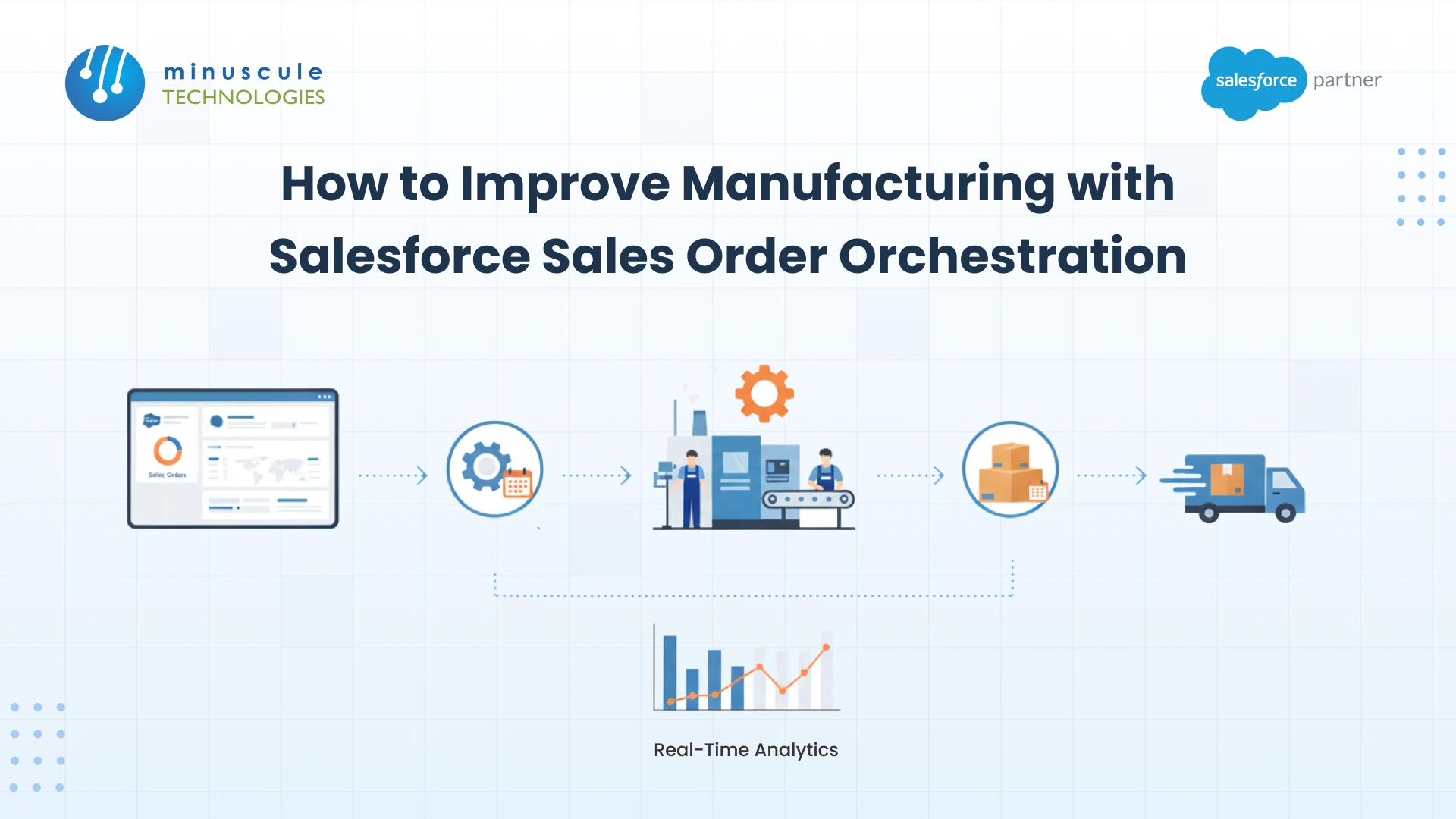
A signed contract is a promise — and for manufacturers, keeping it is often a logistical fight against your own systems. When a sales team closes a complex deal, they're usually working in a fast, modern digital environment. Meanwhile, the operations team building and shipping the product is stuck in rigid, legacy systems that don't talk to the sales tools at all.
That gap is exactly what Salesforce for manufacturing is built to close, and Sales Order Orchestration is the mechanism that does it. The sales rep doesn't know inventory is low, and the plant manager doesn't know a rush order is coming until it's too late. The result: missed deadlines, frustrated customers, and expensive emergency fixes.
Sales Order Orchestration acts as a digital bridge connecting the commercial side of the business with the operational side, so every sales promise is instantly visible to the teams responsible for delivering it. Here's how the pieces fit together, how an order actually moves through the system, and where manufacturers typically get stuck without it.
Order Orchestration isn't one single tool. It's a group of Salesforce tools working together.
Think of it like a smartphone. You use different apps for different jobs, but they all run on one device.
Across the Salesforce for manufacturing industry, silos are common. A silo forms when departments like Sales and Manufacturing don't share data. Order Orchestration breaks these walls down.
Here's how an order moves through the system, step by step.
The customer signs the deal. The price quote turns into an official order right away. No one has to retype anything.
This is the key idea. A customer orders one "Generator System." But the system splits it into three parts:
The system follows the rules. It won't schedule the install team until the machine ships. Everything stays in order, without anyone tracking it by hand.
The customer receives everything. The order becomes an "Asset" on their profile. This matters for warranties. If the machine breaks in two years, support knows exactly which parts went in.
Manufacturers worry about their ERP system. ERP stands for Enterprise Resource Planning. It's the software that manages money and inventory, like SAP or Oracle.
Salesforce doesn't replace the ERP. It works with it. At Minuscule Technologies, we see this as a partnership between systems:
Here's what changes when you move from an ERP-only process to an orchestrated one:
[[HTML TABLE #1 — paste embed here: Traditional ERP-Only Fulfillment vs. Salesforce-Orchestrated Fulfillment]]
Once you build this foundation, you can add more advanced tools:
This is where a Salesforce manufacturer starts to see the platform pay for itself. You get fewer support calls and fewer surprises. Your sales team can trust their promises, instead of guessing.
Want a deeper technical walkthrough? Salesforce Developers covers the automation patterns behind Flow Orchestration. Trailhead also offers a free learning path for Manufacturing Cloud basics.
It works as a digital bridge. It connects your commercial teams (Sales) with your operational teams (Manufacturing and Fulfillment). Sales reps and operations no longer work in separate systems. Every sales promise becomes visible to the people who build and ship the product. This closes the "black hole" where visibility disappears after a contract is signed.
No. Salesforce works alongside your ERP, not in place of it. The ERP stays the system of record for accounting and master data. Salesforce handles speed, customer experience, and order visibility. When a sale happens, Salesforce checks inventory in the ERP right away. Both systems stay in sync, without manual entry.
Order Decomposition splits one complex order into tasks for different departments. Say a customer buys a "Generator System." Salesforce splits the order into three tracks: hardware to the warehouse, software to IT for setup, and service to Field Service for installation. All three tracks move forward at once. No one sorts them by hand.
It builds one source of truth and moves data on its own. In old setups, employees often copy data from a quote or PDF into the ERP by hand. That invites typos. Orchestration turns a signed quote into an order right away. It then sends the data to the right systems, with no manual re-entry.
Yes. Einstein Analytics draws on past data to predict problems. For example, it can flag that East Coast shipments will run two days late, based on weather and past shipping patterns. Your team can then manage customer expectations before the delay hits, instead of reacting to angry calls.
No. Even mid-size manufacturers see fewer fulfillment errors once quote-to-order automation is in place. How complex an order is matters more than company size. If you split orders across shipping, service, and billing today, orchestration pays off at any size.
Manufacturers don't lose deals because sales can't sell — they lose margin and customer trust when the promise made in the CRM doesn't match what the factory floor can actually deliver. That execution gap between commercial commitments and operational reality is what Sales Order Orchestration is built to close.
Minuscule Technologies helps manufacturers navigate exactly this problem, using pre-built Accelerators and Starter Packs to shorten the path from legacy, disconnected systems to a fully orchestrated quote-to-fulfillment process. We don't just implement Order Management - we engineer the digital infrastructure so every commercial commitment is technically validated, operationally visible, and accurately delivered.
If your sales and operations teams are still working from two different versions of the truth, Minuscule Technologies can help you close that gap. Talk to our Salesforce engineering team about what Order Orchestration would look like for your production environment.
You've seen what's possible. Now, let's make it happen for your business. Whether you need an end-to-end Salesforce solution, a complex integration, or ongoing managed services, our team is ready to deliver.

Schedule a Free Strategic Call


