
October 10, 2023
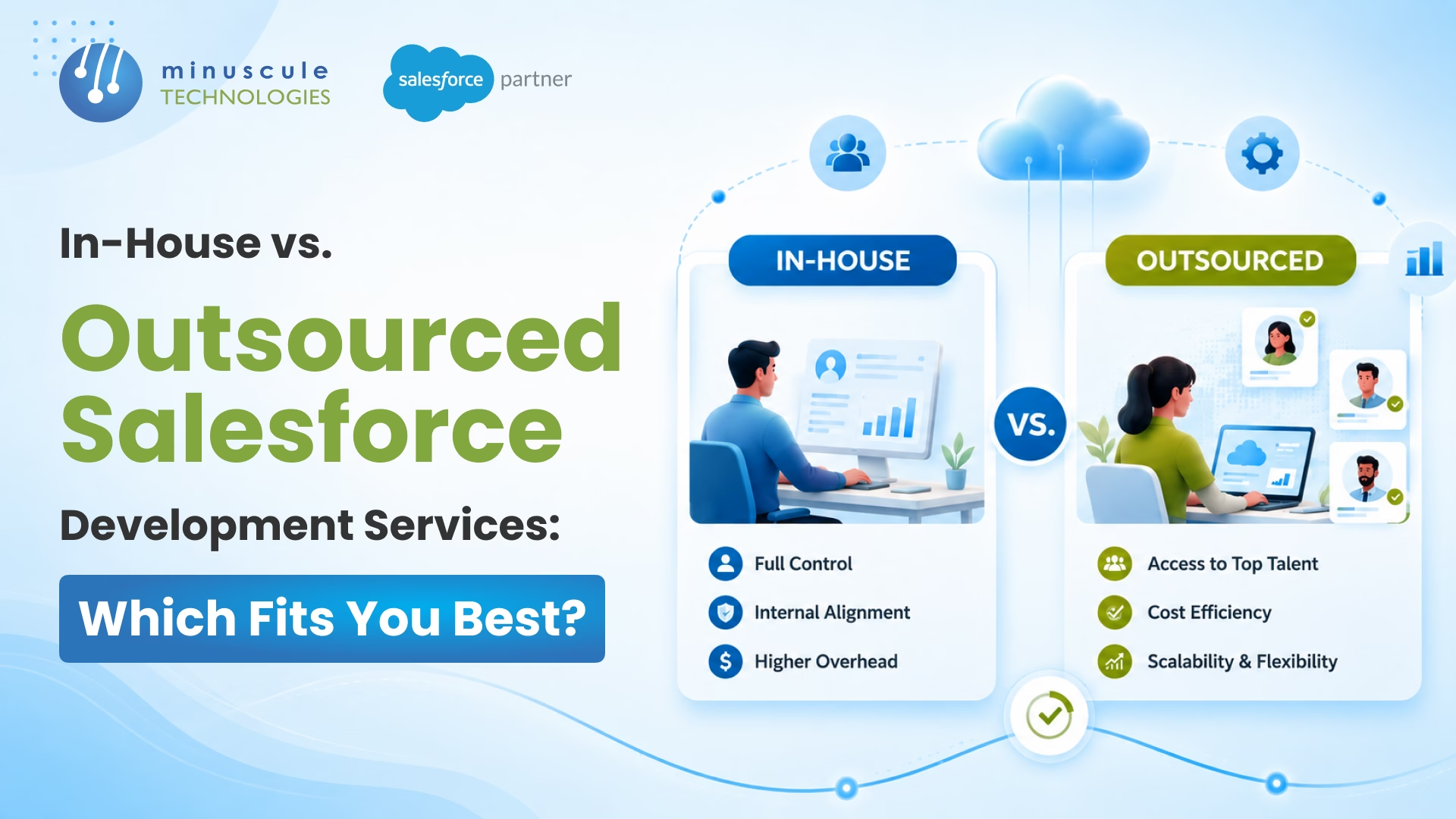
The choice between in-house and outsourced Salesforce development services comes down to four variables: cost, control, expertise, and speed. In-house teams win control and business context; outsourced teams win specialized expertise, scalability, and total cost. Most companies in 2026 land on a hybrid - a small internal core backed by an external engineering bench.
This guide breaks down both models honestly, with the cost data, talent-market reality, and decision factors you need to pick the right one for your business.
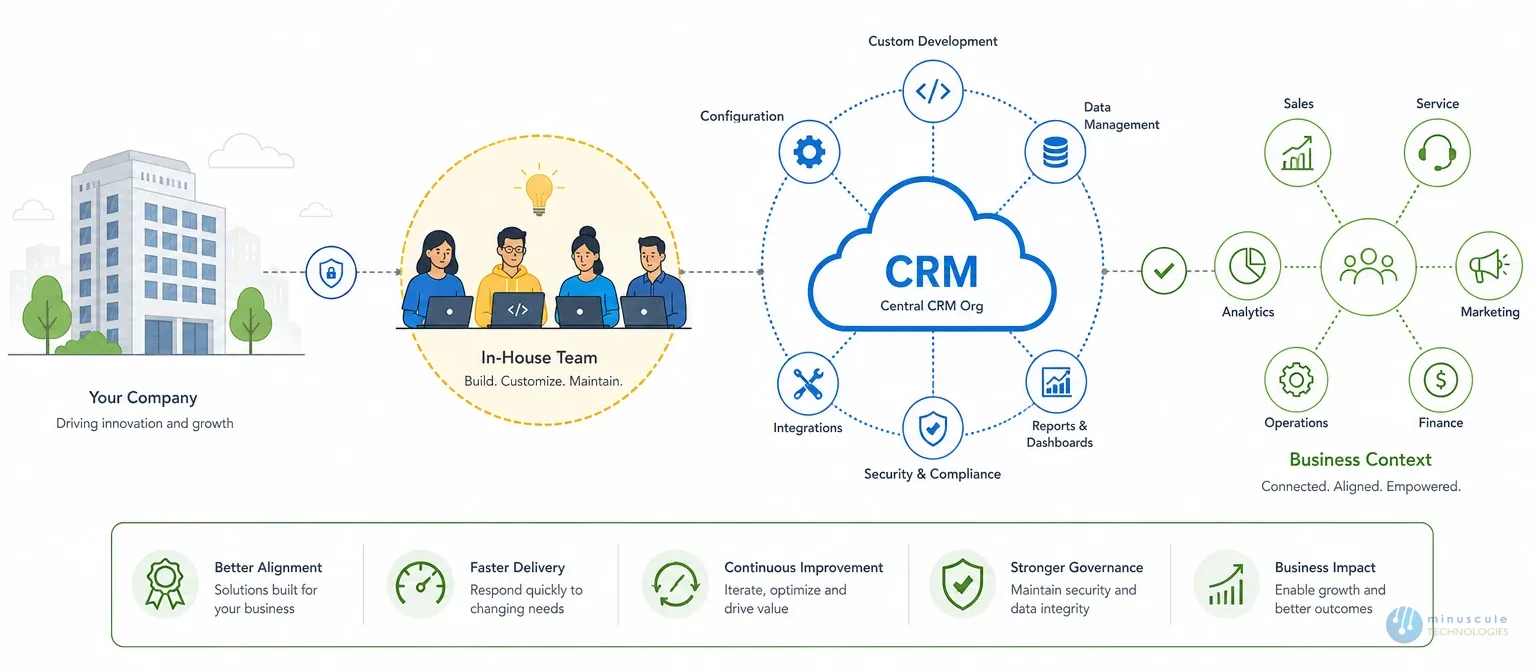
In-house Salesforce development means your own employees build and maintain your org. They sit inside your company, attend your meetings, and absorb your business context daily.
Outsourcing means engaging an external Salesforce development company to handle customization, development, and optimization — instead of building that capability on payroll.
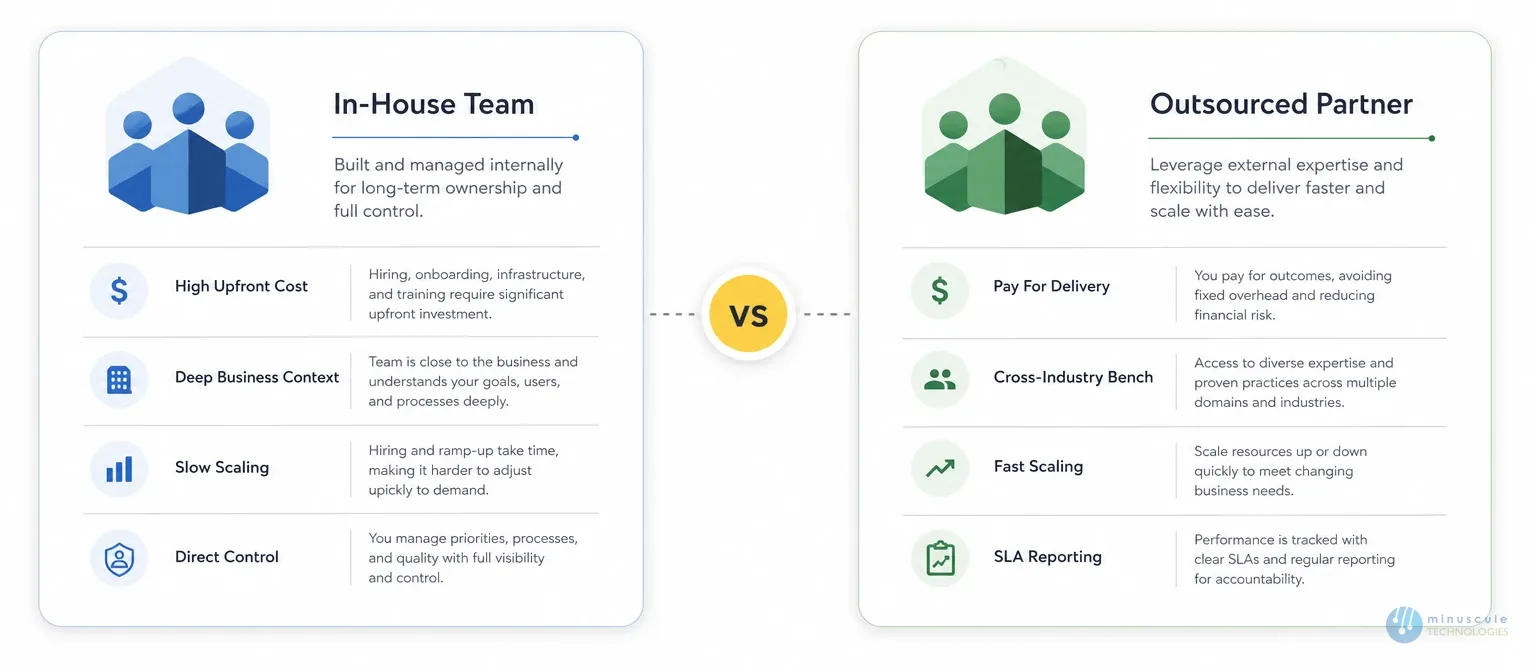
| Factor | In-House Team | Outsourced Partner |
|---|---|---|
| Upfront cost | High — salaries, training, tooling | Low — pay for delivery |
| Ongoing cost | Fixed regardless of workload | Scales with actual need |
| Expertise breadth | Limited to hires' experience | Cross-industry, multi-cloud bench |
| Specialized skills | Hire or train per skill | On demand (mobile, CPQ, AI, integration) |
| Scaling speed | Months (recruit + onboard) | Days to weeks |
| Control | Direct, daily | Contractual — SLAs and reporting |
| Business context | Deep, native | Built through discovery |
| Release readiness | Depends on team discipline | Partner's job to stay current |
Here's the constraint for most comparisons to skip: the market for certified Salesforce developers is brutal.
A salesforce certified platform developer - someone holding Platform Developer I or II credentials{— commands $110K–$160K+ in the US, and senior architects far more. Certifications also expire: Salesforce ships three releases a year, and credential holders must complete maintenance modules for each cycle or lose them. Hiring one certified developer doesn't build a capability; it builds a single point of failure who can leave.
An established partner carries the credential problem for you. Minuscule Technologies, for example, maintains 160+ Salesforce experts across Platform Developer, Platform App Builder, and Architect tracks — current, verified, and backed by bench depth. That's the real economics of the decision: you're not comparing salaries to invoices; you're comparing one hire skills to a certified team's coverage.
In practice, the 2026 answer is rarely either/or. The most common pattern:
This gives you native business context and engineering depth - without paying for where you don't need it. For the app-build-specific version of this decision, see our guide on in-house vs. partner app development.
A US-based certified developer runs $110K–$160K+ in salary, plus 25–40% in benefits, tools, and training — before any bench risk. Outsourced Salesforce development services range from $40–$100/hour offshore to $150–$300/hour onshore, billed only for work delivered.
It depends on the workload shape. Steady, simple, high-context work favors in-house. Spiky, complex, specialized work favors a partner. Mixed workloads — which most companies — favor hybrid.
Custom application development (Apex, Lightning Web Components), integrations with ERPs and external systems, data migration, salesforce mobile app development, release management, and ongoing optimization - everything past the point-and-click ceiling.
Yes, and it's a smart sequence. A good partner documents everything, hands over test coverage, and can train your first internal hires. Ask about knowledge-transfer practices before signing - a partner who resists handover is a red flag.
The in-house vs. outsourced decision isn't about preference - it's about matching your workload shape, budget structure, and talent access to the right model. In-house buys control and context. Outsourcing buys expertise and elasticity. Hybrid buys both, sized to what you actually need.
Minuscule Technologies has operated as a certified Salesforce development partner since 2014 — 160+ certified experts, 75+ projects delivered, and engagement models that flex from single builds to fully managed services. If you're weighing this decision now, we'll give you an honest read — including whether you need us at all.
You've seen what's possible. Now, let's make it happen for your business. Whether you need an end-to-end Salesforce solution, a complex integration, or ongoing managed services, our team is ready to deliver.

Schedule a Free Strategic Call


